
What is a Crypto Wallet? An Analogy Everyone Can Understand
Ever felt like crypto is a secret club and you don’t know the password?
You hear words like ‘wallets’, ‘keys’, and ‘addresses’ thrown around and you’re just supposed to nod along.
Let’s be honest. It’s confusing.
But what if I told you that a crypto wallet is actually simpler than your email inbox?
Stick with me. I’m about to explain it with a simple analogy you’ll never forget.
The Magical Mailbox: Your Crypto Wallet Explained
First things first: forget everything you know about that leather thing in your back pocket.
A crypto wallet has almost nothing in common with a physical wallet.
Instead, I want you to imagine a magical, super-secure mailbox that exists on the internet. This isn’t just any mailbox; it’s your personal mailbox on the blockchain.
This mailbox is designed to do two things perfectly: receive crypto and send crypto.
And just like a real mailbox, it has two key parts: an address and a key.
Your Public Address: The Mailbox Location
Your wallet’s public address is like your home mailing address.
It’s a long string of random letters and numbers that looks something like this: 1A1zP1eP5QGefi2DMPTfTL5SLmv7DivfNa.
You can, and should, share this address freely with anyone who wants to send you crypto. It’s completely safe. Think of it as telling someone where to send you a package. They can put things in, but they can’t open the box.
Your Private Key: The Only Key in the Universe
Now, this is the most important part of our entire chat.
The private key is the only key in the entire universe that can open your magical mailbox.
It is your ultimate secret. Your master password. The keys to the kingdom.
If the public address is for receiving crypto, the private key is what you use to open the box and send crypto out.
You should NEVER, EVER, EVER share your private key with anyone. Seriously. Not your best friend, not your mom, and definitely not that helpful stranger in your DMs.
So, How Does a Crypto Wallet Actually Work?
Here’s the mind-blowing part, the answer to the big question.
Your wallet doesn’t actually ‘hold’ your coins like your physical wallet holds cash.
I know, it’s a weird concept.
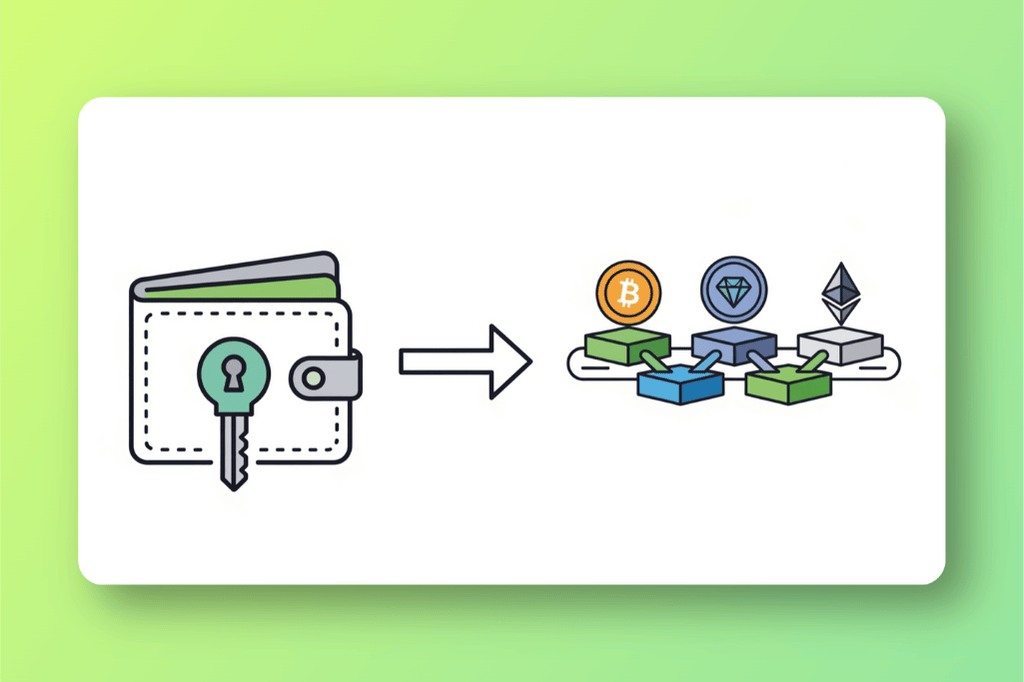
Your coins always live on the blockchain—a giant, public, digital ledger that everyone can see. Your wallet’s job is to hold your private key, which acts as the undeniable proof that you own the coins located at your address on that ledger.
Here’s a real-world example:
Think of your ATM card. The card itself doesn’t have any cash inside it, right? It’s just a piece of plastic. But it holds your PIN and your account info, which gives you access to your money in the bank’s system.
Your crypto wallet is exactly like that. It holds the keys that give you access to your funds on the blockchain.
Wallet vs. Exchange: What’s the Real Difference?
This is easily the biggest point of confusion for beginners, so let’s clear it up with another simple analogy.
Think of an exchange (like Binance or Coinbase) as a bank. You can keep your money (crypto) there, and it’s convenient. But ultimately, the bank is the one holding it for you. They have the keys to the main vault.
A crypto wallet, on the other hand, is like having cash in your own personal safe at home.
You have 100% control. You are your own bank.
This brings us to the most important rule in all of crypto: ‘Not Your Keys, Not Your Coins’. If your crypto is on an exchange, you don’t truly own it. If it’s in your personal wallet, you do.
We wrote a whole article explaining the ‘Not Your Keys, Not Your Coins’ rule here.
The Main Types of Wallets: A Quick Peek
Just like you might have a checking account for daily spending and a high-security savings vault for your life savings, wallets come in two main flavors.
We won’t go too deep right now, but here’s the basic idea:
- Hot Wallets: These are connected to the internet (think mobile apps or browser extensions). They are like your checking account—super convenient for frequent transactions, but you wouldn’t keep your life savings in there.
- Cold Wallets: These are offline devices (like a special USB stick). They are like your savings vault—less convenient to access, but incredibly secure for long-term storage.
Choosing between them is a big decision. Our next guide breaks down everything you need to know about Hot vs. Cold Wallets.
The Point of It All
So, what’s the point of a crypto wallet?
It’s not just about storing crypto. It’s about sovereignty. It’s about giving you complete and total control over your own digital assets without needing to trust a bank or any middleman.
Understanding how it works is the first, most critical step to keeping your crypto safe and truly owning your financial future.
It all comes back to that magical mailbox. You own the address, and more importantly, you are the only one who holds the key. Keep that key safe, and you’ve mastered the most important part of crypto.
Did the ‘magical mailbox’ analogy make sense? Drop a comment below with the #1 question you still have about crypto wallets. I’m replying to every single one!